Showing posts with label history. Show all posts

Saturday, 25 February 2012

history of microsoft


Microsoft was formed by a Harvard College Dropout called Bill Gates. Bill Gates was born William Henry Gates III on October 28, 1955. He was born to a family that was successful in business, living a comfortable upper middle class life in Seattle, Washington.
Early in his elementary school days, Bill Gates quickly shot to the head of the class, consistently outscoring his peers in most subjects, but especially math and science. His parents soon enrolled him in Lakeside Prep School, where the atmosphere was intellectual enough to stimulate the young Gates. This move to Lakeside would prove historic, for it was here, in the spring of 1968, that he was introduced to computers.
At that time, computers were still too large and expensive for the school to purchase one of its own. Over the next ten months or so, the school struck agreements with various corporations who allowed the students to use their computers. Bill Gates, his buddy Paul Allen and a handful of others quickly took to computing. In fact, they began to skip classes, opting instead to stay in the computer room and write programs, read computer books and find out exactly how these machines worked. They soon learned to hack the system, and altered and crashed valuable files until they were banned from the computer. Soon, however, Bill and his friends were actually hired by the computer company to find bugs and explore weaknesses in the system, which kept causing the computers to crash. Instead of paying the boys for their time, they were granted something even better--unlimited computer time.
Gates has been quoted as saying that that was the time when he got into computers fulltime. "I mean, then I became hardcore. It was day and night," he said. The boys used their time eating, drinking and breathing computers. They studied manuals, explored the system, and hounded the employees with questions until they had formed a base of knowledge that would eventually lead to the formation of Microsoft.
The computer company that was hiring the group went out of business in 1970, and the boys had to find alternate sources for computer time. They were soon hired by Information Sciences Inc. to write a program for payroll. This time they actually earned money as well as enjoying the unlimited computer time. It was during this time that the group gained notoriety for their skill in computer programming. They were hired or contracted by various organizations to find bugs and fix them. Each job helped Gates and his friends learn their skill and delve ever deeper into the world of programming.
In the fall of 1973, Gates left for Harvard University. He enrolled as a prelaw student, but spent most of his time in the campus computer center, programming away. He stayed in touch with Paul Allen and they continued to talk about future projects and the possibility of one day having their very own business. Allen even moved to Boston to be closer to Gates, so they could continue working on projects. Allen continually urged Gates to quit school and work with him full-time, and Gates was unsure of what he wanted to do. This was soon to change.
One year later, Paul Allen saw the first microcomputer on the cover of a magazine. He bought the magazine and went immediately to show it to Gates. They realized the time was right. The home PC business was about to explode and someone would need to provide software for the machines. By stretching the truth somewhat, Gates arranged for a meeting with the Altair manufacturers. He had called them to let them know he had a program written for them. After the appointment was made, Gates and Allen stayed up for nights, feverishly writing the program he had promised. It worked perfectly at the meeting, and everyone was impressed. They sold the program, and saw that this was something they could do for real. Within a year, Gates had dropped out of Harvard and Microsoft was formed.
The company went through some rough first years, but eventually were able to license MS-DOS to IBM. The IBM PC took the public by storm, and its success signaled the success of Microsoft. Microsoft continued writing software, for businesses as well as the consumer market. In 1986, the company went public, and Gates became a 31-year old billionaire. The next year, the first version of windows was introduced, and by 1993 a million copies per month were being sold.
In 1995, Gates knew that the Internet was the next area of focus, and the course of Microsoft shifted dramatically. The popular Internet Explorer browser soon became a bestseller. Today, Microsoft software is everywhere.

Friday, 24 February 2012

history of apple logo

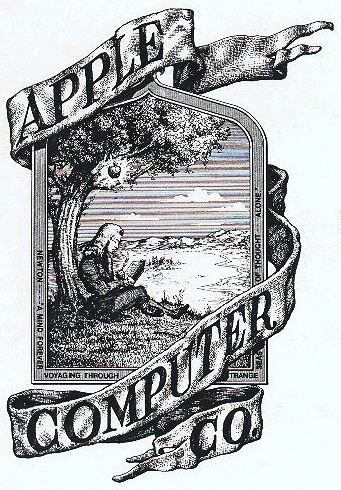
The Newton Crest: 1976-1976
The first Apple logo was designed in 1976 by Ronald Wayne, sometimes referred to as the third co-founder of Apple. The logo depicts Isaac Newton sitting under a tree, an apple dangling precipitously above his head. The phrase on the outside border reads, “Newton… A Mind Forever Voyaging Through Strange Seas of Thought … Alone.”

The Rainbow Logo: 1976-1998
Not surprisingly, the above logo only lasted a year before Steve Jobs commissioned graphic designer Rob Janoff to come up with something, oh I don’t know, a little bit more modern. Janoff’s eventual design would go on to become one of the most iconic and recognizable corporate logos in history.
According to Janoff, the “bite” in the Apple logo was originally implemented so that people would know that it represented an apple, and not a tomato. It also lent itself to a nerdy play on words (bite/byte), a fitting reference for a tech company. Quick sidenote: Corporate design sure was a lot simpler in the 70′s. Nowadays, companies like Pepsi spend millions of dollars on logo re-designs that are based on complete BS and new age mumbo jumbo.

As for the rainbow stripes of the logo, Steve Jobs is rumored to have insisted on using a colorful logo as a means to “humanize” the company. Janoff has said that there was no rhyme or reason behind the placement of the colors themselves, noting that he wanted to have green at the top “because that’s where the leaf was.”
The relatively simple origins of the rainbow colored Apple logo hasn’t stopped some from reading a bit too much into what it represents. Jean-Louis Gassée, former Apple executive and founder of BeOS, quipped about the logo:
One of the deep mysteries to me is our logo, the symbol of lust and knowledge, bitten into, all crossed with the colors of the rainbow in the wrong order. You couldn’t dream a more appropriate logo: lust, knowledge, hope and anarchy.
The passion of the French knows no bounds!
The multi-colored Apple logo was in use for 22 years before it was axed by Steve Jobs less than a year after his return to Apple in 1997. In its place was a new logo that did away with the colorful stripes and replaced it with a more modern monochromatic look that has taken on a variety of sizes and colors over the past few years. The overall shape of the logo, however, remains unchanged from its original inception 33 years ago.
The Monochrome Logo: 1998 – Present
TInkering with one of the most recognizable logos in the world wasn’t done simply because Steve Jobs is always looking to change things up. When Jobs returned to Apple in 1997, the company was bleeding money, and Jobs and Co. realized that the Apple logo could be leveraged to their advantage. That meant experimenting with larger logos to make it more prominent.  If the shape of the Apple logo was universally recognizable, why not not put it where people could see it?

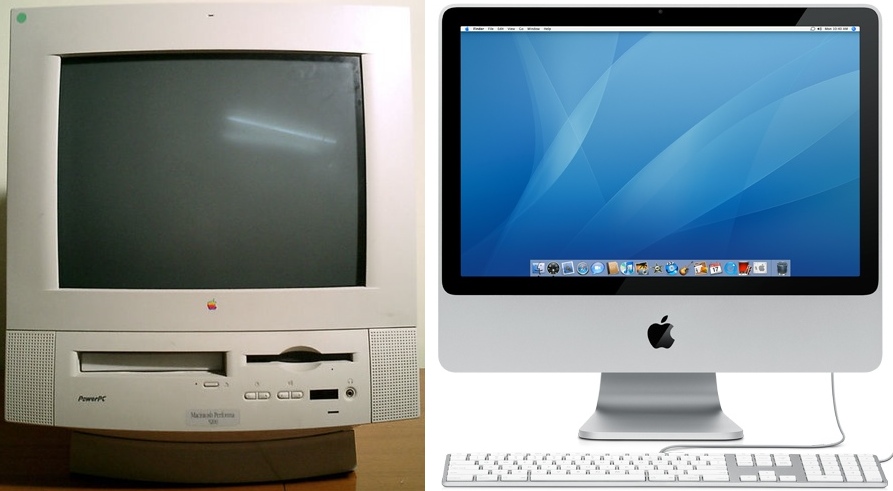
That being the case, placing a large rainbow Apple logo on top of the original Bondi Blue iMac, for example, would have looked silly, childish, and out of place. Not exactly the direction Jobs wanted to lead Apple in.  So instead of placing a somewhat minuscule rainbow colored Apple logo on its products, Apple began placing sizeable and Monochrome styled logos on its products in all sorts of places:  on top of the original iMac, on the side of the Powermac G3 Tower, and in an assortment of colors on the good ole iBooks.  This trend, which began in 1998, continues to this day.
The rainbow colored logo might always be a source of nostalgia for Mac enthusiasts, but the monochrome logo allows Apple greater flexibility when it comes to branding its products.  Also, Steve Jobs isn’t exactly the type to get wrapped up in warm fuzzy feelings of nostalgia.  When Jobs returned to Apple, he needed to transform Apple’s image from that of a failing company into one capable of churning out sleek and cutting edge products, and he needed a new logo to match.  It doesn’t appear likely that Apple will change up its logo again anytime soon, but one thing that will undoubtedly remain is the shape of the logo itself.
Why Apple had to abandon the rainbow
The rainbow logo just wouldn’t fit on the iMac pictured to the right.  Rainbow on beige? Alright.  Rainbow on metal?  Not so much.

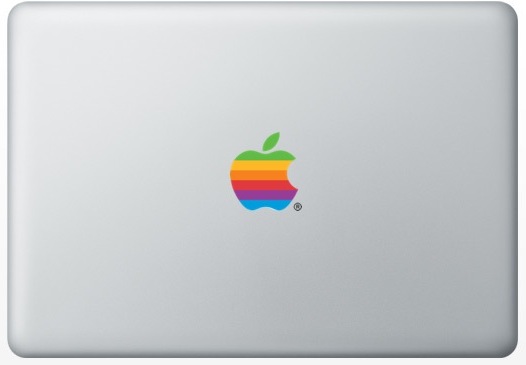
Imagine if MacBooks looked like this?! I think Apple made the right call.

history of indian cinema


In 1886 the Lumiere Brothers Cinematographe unveiled six soundless short films at Bombay's Watson's Hotel. Soon after, Hiralal Sen and H.S. Bhatavdekar started making films in Calcutta and Bombay, respectively. Like Lumiere Brothers Bhatavdekar made India's first actuality films in 1899. Tough there were efforts at filming stage plays earlier India's first feature film Raja Harishchandra was made in 1913 by Dadasaheb Phalke who is known as the Father of Indian Cinema. By 1920 there was a regular industry bringing out films starting with 27 per year and reaching 207 films in 1931. Today India makes about 800 feature films every year.

Alam Ara (1931) was the genesis of the talkie feature films. The film's popular Hindustani dialogues and seven songs made it a big hit which resulted in other filmmakers to raise the number of songs in their films till it reached a whooping 71 in "Indrasabha". Film songs became a Pan-Indian phenomenon.

The most remarkable things about the birth of the sound film in India are that it came with a bang and quickly displaced the silent movies. The first Indian talkie Alam Ara produced by the Imperial film company and directed by Ardershir Irani was released on March 14, 1931 at the Majestic Cinema in Bombay; the talkie had brought revolutionary changes in the whole set up of the industry. The year 1931 marked the beginning of the talking ear in Bengal and South India. The first talkie films in Bengali (Jumai Shasthi), Telugu (Bhakta Prahlad) and Tamil (Kalidass) were released in the same year.

Regional culture and craving to see-hear a film in one's own language caused the mushrooming of the regional film industries beginning with Bengali, Tamil & Telugu followed by Marathi, Gujarati, Kannada, Malayalam, Oriya, Assamese, English and several other dialects.

history of computer

The first computers were people! That is, electronic computers (and the earlier mechanical computers) were given this name because they performed the work that had previously been assigned to people. "Computer" was originally a job title: it was used to describe those human beings (predominantly women) whose job it was to perform the repetitive calculations required to compute such things as navigational tables, tide charts, and planetary positions for astronomical almanacs. Imagine you had a job where hour after hour, day after day, you were to do nothing but compute multiplications. Boredom would quickly set in, leading to carelessness, leading to mistakes. And even on your best days you wouldn't be producing answers very fast. Therefore, inventors have been searching for hundreds of years for a way to mechanize (that is, find a mechanism that can perform) this task.


This picture shows what were known as "counting tables" [photo courtesy IBM]


A typical computer operation back when computers were people.
The abacus was an early aid for mathematical computations. Its only value is that it aids the memory of the human performing the calculation. A skilled abacus operator can work on addition and subtraction problems at the speed of a person equipped with a hand calculator (multiplication and division are slower). The abacus is often wrongly attributed to China. In fact, the oldest surviving abacus was used in 300 B.C. by the Babylonians. The abacus is still in use today, principally in the far east. A modern abacus consists of rings that slide over rods, but the older one pictured below dates from the time when pebbles were used for counting (the word "calculus" comes from the Latin word for pebble).


A very old abacus


A more modern abacus. Note how the abacus is really just a representation of the human fingers: the 5 lower rings on each rod represent the 5 fingers and the 2 upper rings represent the 2 hands.
In 1617 an eccentric (some say mad) Scotsman named John Napier invented logarithms, which are a technology that allows multiplication to be performed via addition. The magic ingredient is the logarithm of each operand, which was originally obtained from a printed table. But Napier also invented an alternative to tables, where the logarithm values were carved on ivory sticks which are now called Napier's Bones.


An original set of Napier's Bones [photo courtesy IBM]


A more modern set of Napier's Bones
Napier's invention led directly to the slide rule, first built in England in 1632 and still in use in the 1960's by the NASA engineers of the Mercury, Gemini, and Apollo programs which landed men on the moon.


A slide rule
Leonardo da Vinci (1452-1519) made drawings of gear-driven calculating machines but apparently never built any.


A Leonardo da Vinci drawing showing gears arranged for computing
The first gear-driven calculating machine to actually be built was probably the calculating clock, so named by its inventor, the German professor Wilhelm Schickard in 1623. This device got little publicity because Schickard died soon afterward in the bubonic plague.


Schickard's Calculating Clock
In 1642 Blaise Pascal, at age 19, invented the Pascaline as an aid for his father who was a tax collector. Pascal built 50 of this gear-driven one-function calculator (it could only add) but couldn't sell many because of their exorbitant cost and because they really weren't that accurate (at that time it was not possible to fabricate gears with the required precision). Up until the present age when car dashboards went digital, the odometer portion of a car's speedometer used the very same mechanism as the Pascaline to increment the next wheel after each full revolution of the prior wheel. Pascal was a child prodigy. At the age of 12, he was discovered doing his version of Euclid's thirty-second proposition on the kitchen floor. Pascal went on to invent probability theory, the hydraulic press, and the syringe. Shown below is an 8 digit version of the Pascaline, and two views of a 6 digit version:


Pascal's Pascaline [photo © 2002 IEEE]


A 6 digit model for those who couldn't afford the 8 digit model


A Pascaline opened up so you can observe the gears and cylinders which rotated to display the numerical result
Click on the "Next" hyperlink below to read about the punched card system that was developed for looms for later applied to the U.S. census and then to computers...
Related Posts Plugin for WordPress, Blogger...